
 Resources
Teen Destroying Property at Home: Is It a Mental Health Crisis?
Published On 18-10-2026
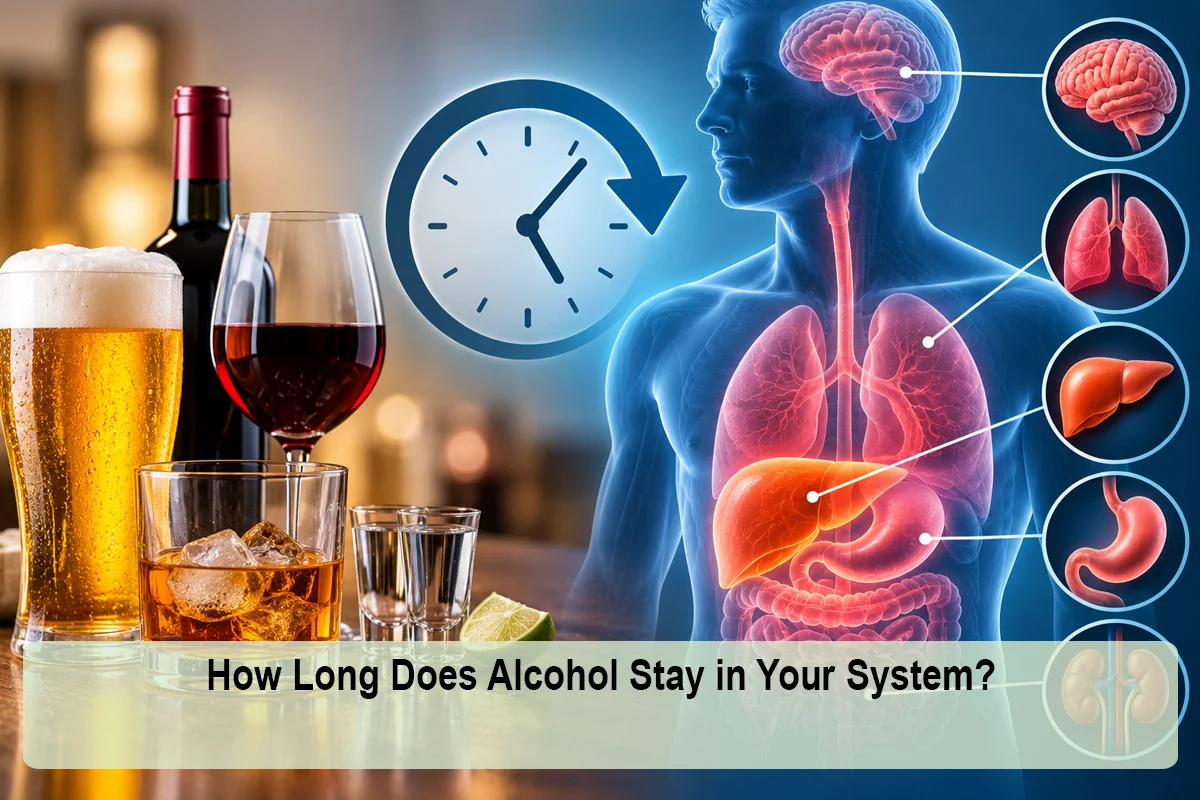
"How long does alcohol stay in your system?" has two very different answers depending on what you are really asking. If you want to know when you will no longer be impaired or over the legal driving limit, the answer is measured in hours. If you are facing an alcohol test for work, probation, a professional monitoring program, or a transplant evaluation, the answer can be days or even weeks, because modern tests detect byproducts that linger long after the alcohol itself is gone. This guide covers both, explains each type of test, and clears up common misunderstandings.
After you drink, alcohol is absorbed into the bloodstream mainly through the stomach and small intestine. Food in the stomach slows absorption, which is why drinking on an empty stomach leads to a faster and higher peak in blood alcohol concentration (BAC).
The liver does most of the work of breaking alcohol down, and it does so at a fairly steady rate. On average, BAC falls by roughly 0.015 g/dL per hour, though individual rates vary. That means someone with a BAC of 0.08, the legal driving limit in most U.S. states, needs about five to six hours for their BAC to return to zero. Someone with a BAC of 0.16 may need ten hours or more.
A small fraction of alcohol is processed differently, creating byproducts such as ethyl glucuronide (EtG), ethyl sulfate (EtS), and phosphatidylethanol (PEth). These are only produced when alcohol is consumed, and they remain in the body much longer than alcohol itself. That is what allows extended alcohol testing.
Detection estimates and BAC calculations depend on knowing how much alcohol was actually consumed. In the United States, a standard drink contains about 14 grams of pure alcohol. That equals roughly 12 ounces of regular beer at about 5 percent alcohol, 5 ounces of wine at about 12 percent, or 1.5 ounces of 80-proof spirits.
Real drinks often contain more than one standard drink. A large pour of wine, a craft beer with 8 or 9 percent alcohol, or a mixed drink with several shots can each count as two or three standard drinks. People routinely underestimate how much they have had, which is one reason they are surprised by how long alcohol stays in their system or by a positive test the next day. Counting standard drinks honestly is the first step to understanding any alcohol test result.
| Test | What It Measures | Approximate Detection Window | Typical Uses |
|---|---|---|---|
| Breath (breathalyzer) | Alcohol in exhaled air | Up to about 12 to 24 hours, depending on amount | Roadside testing, workplace, ignition interlocks |
| Blood (BAC) | Alcohol in blood | Up to about 12 hours | Hospitals, DUI investigations |
| Urine (ethanol) | Alcohol in urine | Up to about 12 to 24 hours | Some basic screens |
| Urine EtG and EtS | Alcohol byproducts | About 24 to 48 hours after light drinking; up to about 80 hours after heavy drinking | Probation, professional monitoring, treatment programs |
| Blood PEth | Alcohol byproduct in red blood cells | Roughly 2 to 4 weeks, longer after heavy use | Transplant programs, medical monitoring, custody cases |
| Hair EtG | Alcohol byproduct in hair | Up to about 90 days | Some legal and custody cases |
These windows depend heavily on how much was consumed, individual metabolism, and the cutoff level the lab uses.
Breath and blood tests measure alcohol that is currently in the body. That makes them the right tools for assessing impairment, such as at a DUI stop. They cannot tell whether someone drank two days ago.
A crucial point for anyone who drives: BAC can stay above the legal limit well into the next morning after a heavy night. Sleep does not speed up the liver. If someone stops drinking at 2 a.m. with a BAC of 0.20, they may still be over 0.08 at 9 or 10 a.m. Many people arrested for drunk driving are pulled over the morning after, believing they have "slept it off." Our guide on how to sober up explains why time is the only thing that actually lowers BAC.
Ethyl glucuronide (EtG) urine testing is widely used to monitor abstinence, for example in probation, professional health programs, and addiction treatment. It is often called the 80-hour test, but that label is misleading. The full 80-hour window generally applies to heavy drinking. After light drinking, EtG may be detectable for only about 24 to 48 hours. Ethyl sulfate (EtS) is often tested alongside EtG to strengthen results.
Labs commonly use tiered EtG cutoffs, such as 100 ng/mL, 500 ng/mL, and higher. Lower cutoffs are more sensitive and can detect lighter or less recent drinking, but they are also more likely to pick up incidental exposure. Higher cutoffs, such as 500 ng/mL, are much less likely to be triggered by incidental exposure.
Alcohol is present in many everyday products, including hand sanitizer, mouthwash, some cough and cold medicines, and certain foods. Heavy, repeated use of these products can produce low-level EtG. In its advisory on alcohol biomarkers, the Substance Abuse and Mental Health Services Administration (SAMHSA) cautioned that a positive EtG test by itself should not be considered definitive proof that someone drank, and that results should be interpreted alongside other evidence.
If you are in a monitoring program, ask for a list of products to avoid. Many programs instruct participants to use alcohol-free mouthwash and hand sanitizer and to check medication labels.
Phosphatidylethanol (PEth) is formed only when alcohol is present and builds up in the membranes of red blood cells. It is measured with a blood test, often a simple finger-stick dried blood spot. PEth can reflect drinking over roughly the previous two to four weeks, and higher levels generally indicate heavier or more frequent drinking.
Because PEth is not affected by incidental exposure to hand sanitizer or mouthwash in the way that EtG can be, and because it covers a longer window, it is increasingly used in liver transplant programs, medical monitoring, and other settings where an accurate picture of recent drinking matters. Our article on addiction treatment for medically complex patients explains how transplant teams use alcohol testing.
Hair testing for EtG can provide a picture of drinking over roughly the past three months, since hair grows about a centimeter per month. It is used in some legal and custody cases. Hair testing is better at identifying sustained heavy drinking than occasional light drinking, and results can be affected by hair treatments such as bleaching.
Coffee, cold showers, exercise, drinking water, eating after drinking, and sleeping do not make the liver process alcohol faster. Some may help a person feel more alert, but BAC continues to fall at roughly the same rate regardless. Drinking large amounts of water may dilute urine, but labs check for dilution and will often treat a very dilute sample as a problem rather than a pass.
Many people encounter extended alcohol testing because of a DUI, probation, a professional license, a custody arrangement, or a medical procedure. If you are being monitored, the most reliable path is complete abstinence along with careful avoidance of products that contain alcohol. Keep receipts or documentation for any medications that may contain alcohol.
If staying alcohol-free for testing feels very difficult, or if you find yourself repeatedly drinking despite knowing a test is coming, that is important information. It may mean that drinking has become harder to control than it seems. Our guide to when drinking becomes alcohol use disorder walks through the criteria clinicians use.
If you drink heavily every day and need to stop for a test or for any other reason, do not stop suddenly without medical advice. Alcohol withdrawal can cause seizures and delirium tremens, which can be life-threatening. A doctor or medical detox program can help you stop safely. Our article on why alcohol withdrawal can require medical supervision explains the risks and how they are managed.
Alcohol itself clears the bloodstream at roughly 0.015 g/dL per hour, so most people are alcohol-free on a breath or blood test within about 12 to 24 hours of drinking, depending on how much they consumed. Byproducts last much longer: EtG and EtS in urine for about one to three days, PEth in blood for roughly two to four weeks, and EtG in hair for up to about 90 days. Nothing speeds up the liver. If you are being tested, abstinence and avoiding alcohol-containing products is the only reliable approach, and if that feels impossible, it may be time to talk to someone about your drinking.
This article was reviewed by the RehabsNearMe Editorial Team for accuracy, clarity, and relevance. Information may be sourced from publicly available treatment resources, government agencies, and healthcare references where applicable.
Last reviewed: October 2026
Resources
 Resources
 Resources
 Resources