
 Resources
15 Art Therapy Ideas for Teens: Activities for Anxiety, Anger, and Self-Esteem
Published On 15-10-2026
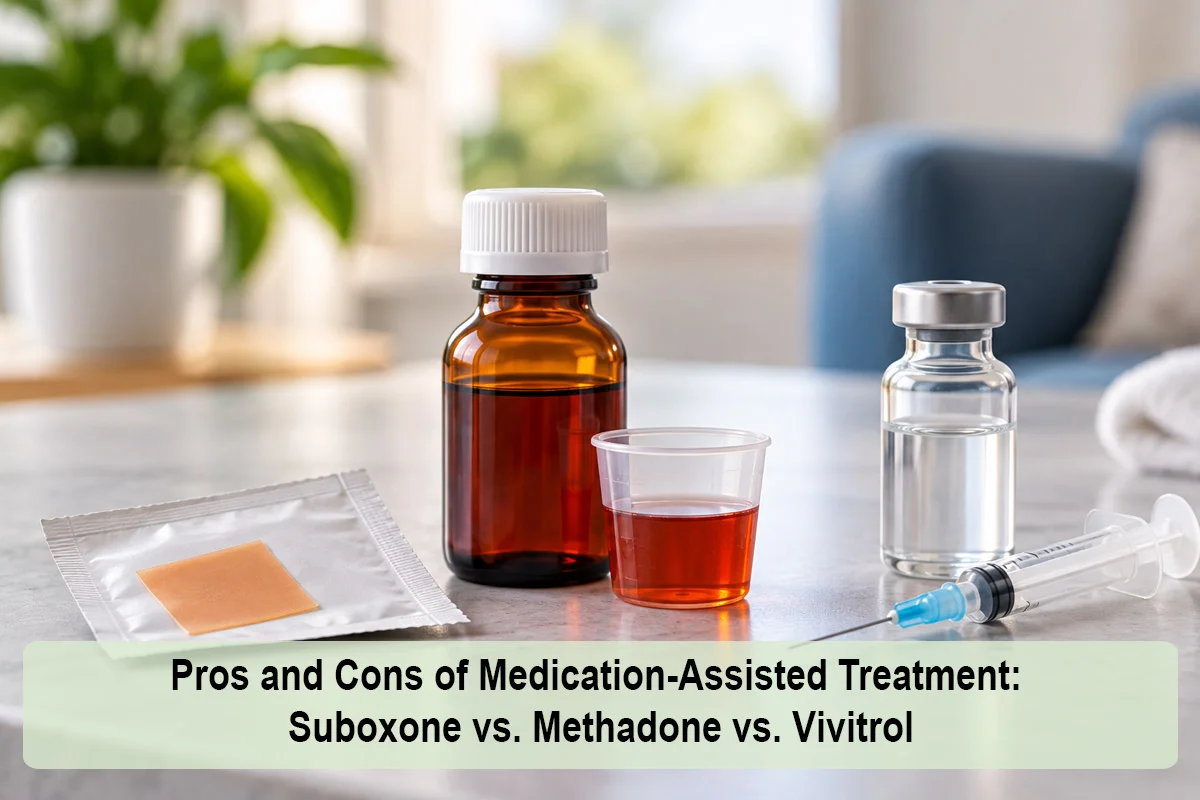
Three medications are FDA-approved to treat opioid use disorder: buprenorphine (often sold as Suboxone), methadone, and extended-release naltrexone (Vivitrol). All three can be part of what is often called medication-assisted treatment, or MAT, now commonly called medications for opioid use disorder (MOUD). They work in very different ways, and each has real strengths and real drawbacks. Choosing among them is one of the most important decisions in opioid recovery. This guide compares the pros and cons of each, summarizes what head-to-head research shows, and covers recent federal rule changes that affect access. If you want a basic introduction first, see our overview of medication-assisted treatment.
| Buprenorphine (Suboxone and others) | Methadone | Extended-Release Naltrexone (Vivitrol) | |
|---|---|---|---|
| How it works | Partial opioid agonist: activates receptors enough to prevent withdrawal and cravings, with a ceiling on effects | Full opioid agonist: long-acting, fully activates receptors | Opioid antagonist: blocks receptors so opioids have little effect |
| Where it is given | Prescribed by clinicians in offices, clinics, or by telehealth; filled at pharmacies | Only through certified opioid treatment programs (OTPs) | Monthly injection in a clinic or office |
| Starting requirements | Must be in some withdrawal to avoid precipitated withdrawal, or use a low-dose start | Can be started without withdrawal | Must be fully off opioids, usually 7 to 10 days |
| Forms | Daily film or tablet; weekly or monthly injections | Daily liquid or tablet | Monthly injection |
| Overdose risk reduction | Strong evidence | Strong evidence | Less established in population studies |
| Misuse and diversion potential | Low to moderate | Moderate; controlled through OTP dosing | None |
SAMHSA's 2024 update to the federal rules governing opioid treatment programs, 42 CFR Part 8, expanded flexibility. Changes include allowing more take-home doses earlier in treatment, permitting telehealth for certain parts of care, and removing the requirement of a one-year history of addiction before admission. The full rule is published in the Federal Register. How quickly individual clinics adopt these flexibilities varies.
A major National Institute on Drug Abuse Clinical Trials Network study, known as X:BOT and summarized in a review of the network's opioid use disorder trials published on the NIH's PubMed Central, compared extended-release naltrexone with buprenorphine-naloxone in 570 adults starting treatment. Published in The Lancet in 2018, the trial found that many more participants failed to start naltrexone because of the need for full detox. In the overall group, relapse was more common among those assigned to naltrexone. However, among people who successfully started their assigned medication, outcomes were similar.
The lesson is practical: naltrexone can work as well as buprenorphine for people who get through induction, but induction is a major hurdle.
Observational studies have also compared real-world outcomes. One large study of overdose survivors in Massachusetts, published in Annals of Internal Medicine in 2018, found that treatment with methadone or buprenorphine was associated with significantly lower risk of death in the following year, while naltrexone was not associated with a significant reduction, though fewer people received it.
No. Addiction involves compulsive use, loss of control, and continued use despite harm. People stable on prescribed buprenorphine or methadone take a measured dose that prevents withdrawal and cravings without producing a high, allowing them to work, parent, and rebuild their lives. Physical dependence on a medication is not the same as addiction, much like dependence on insulin or blood pressure medication.
There is no fixed endpoint. Research generally shows better outcomes with longer treatment, and stopping too early is linked to higher relapse and overdose risk. Decisions about tapering should be made with a clinician when a person is stable. Our article on detox vs. medication treatment for opioid use disorder explains why detox alone carries risk.
Methadone and buprenorphine are recommended treatments for opioid use disorder during pregnancy because they reduce the risks associated with ongoing opioid use and withdrawal. Evidence for naltrexone during pregnancy is more limited. Our guide to substance use treatment during pregnancy covers this in detail.
Coverage for all three medications has expanded considerably. Medicaid programs in every state cover medications for opioid use disorder, and Medicare covers opioid treatment program services, including methadone. Most commercial plans cover buprenorphine and naltrexone, though prior authorization or pharmacy restrictions sometimes apply. Monthly injectable forms of buprenorphine and naltrexone are more expensive than daily medications, which can affect coverage decisions. Before starting, ask your insurer which medications and formulations are covered and whether prior authorization is needed. Our guide to verifying insurance benefits for treatment explains which questions to ask.
The best medication is the one a person can start, stay on, and benefit from. Switching is possible if the first choice does not work. Medication works best combined with counseling and support. You can find programs on our medication-assisted treatment page, through SAMHSA's FindTreatment.gov, or by calling the SAMHSA National Helpline at 1-800-662-4357.
Buprenorphine offers flexible, office-based treatment with strong evidence for reducing overdose deaths but can be tricky to start with fentanyl. Methadone is the most powerful option and has the longest track record, but requires opioid treatment program visits, though 2024 federal rule changes expanded take-home flexibility. Naltrexone avoids opioids entirely and is given monthly, but requires full detox first and has less evidence for preventing deaths. The NIDA X:BOT trial showed naltrexone and buprenorphine perform similarly once started, but starting naltrexone is much harder. Each option can save lives, and the right choice depends on the person.
This article was reviewed by the RehabsNearMe Editorial Team for accuracy, clarity, and relevance. Information may be sourced from publicly available treatment resources, government agencies, and healthcare references where applicable.
Last reviewed: October 2026
Resources
 Resources
 Resources
 Resources