
 Resources
15 Art Therapy Ideas for Teens: Activities for Anxiety, Anger, and Self-Esteem
Published On 15-10-2026
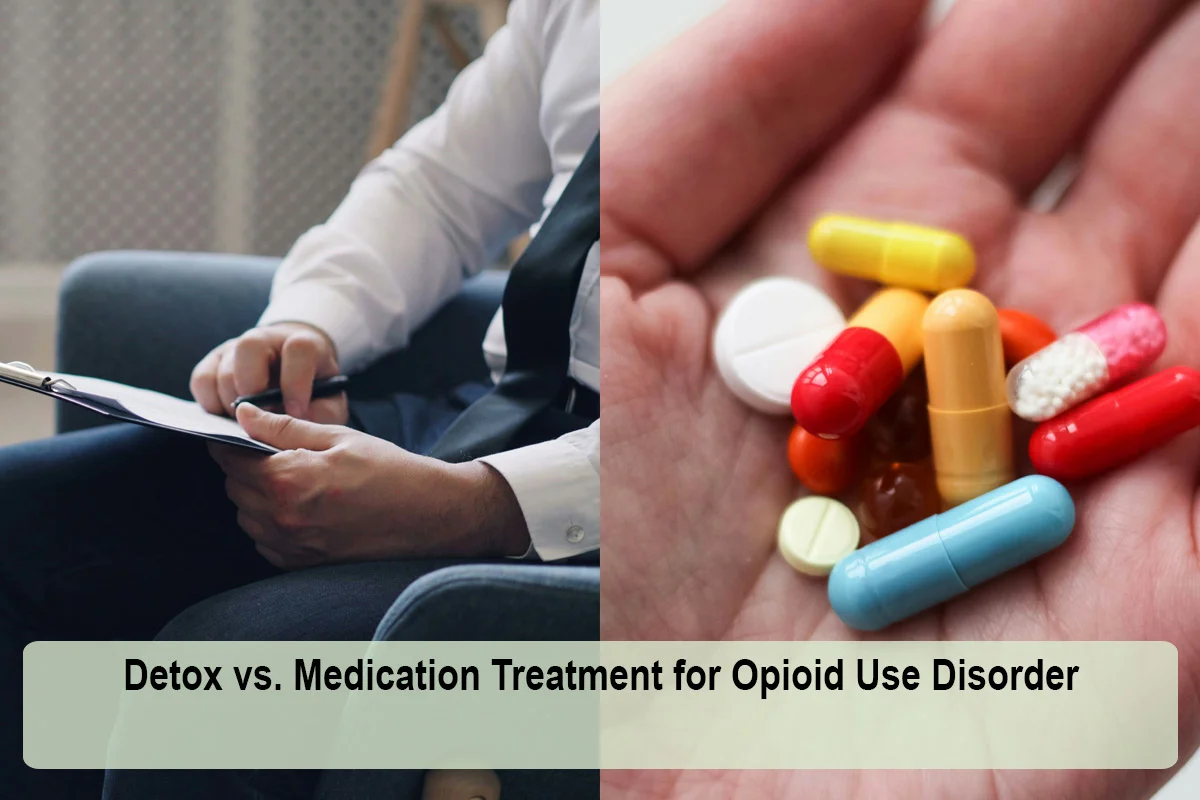
Our guide to what happens during opioid detox walks through the mechanics of the withdrawal process itself. This piece answers a different, more consequential question that families and patients often face right after: once withdrawal is managed, should the goal be complete abstinence achieved through detox alone, or should medication continue long-term? The research on this question is more decisive than most people expect.
Detox alone, sometimes called medically managed withdrawal, resolves acute physical withdrawal symptoms over roughly five to ten days and then discontinues any medication used to manage that process, with the goal of complete abstinence going forward. Medication treatment, using buprenorphine, methadone, or in some cases naltrexone, continues a medication on an ongoing basis, sometimes for months, sometimes indefinitely, specifically to manage the underlying opioid use disorder rather than only the acute withdrawal period.
These are not simply two flavors of the same treatment. They represent genuinely different models of what opioid use disorder is and how it should be managed, abstinence achieved through short-term intervention versus a chronic condition managed with ongoing medication, similar to how many other chronic diseases are managed with long-term medication rather than a single course of treatment.
This is one of the more settled questions in addiction medicine, even though public perception often has not caught up with the evidence. A clinical review of level 1 evidence, randomized controlled trials, systematic reviews, and high-quality cohort studies, found consistently improved treatment retention, lower relapse rates, and decreased risk of overdose and mortality among patients who received buprenorphine maintenance therapy compared to those who underwent detoxification alone. The Cochrane Collaboration, widely regarded as a gold standard for evidence synthesis in medicine, has reached a similar conclusion: medically supervised withdrawal without ongoing maintenance medication is not the favored approach for opioid use disorder, precisely because relapse rates following detox alone are so high and the post-detox period carries meaningfully elevated overdose risk.
The mortality data is the most striking part of this picture. A meta-analysis cited in a review published in Frontiers in Psychiatry found the risk of death due to overdose in patients receiving no medication treatment was eight times higher than in those receiving medication treatment. A separate NIH-funded study analyzing over 17,000 opioid overdose survivors in Massachusetts found buprenorphine reduced opioid-related deaths by 38 percent and methadone reduced deaths by 59 percent, compared to no medication treatment, over a 12-month period. A systematic review published in JAMA Psychiatry found all-cause mortality during methadone or buprenorphine maintenance was less than half the rate compared to being outside of treatment, with lower rates not just of overdose but of suicide, cardiovascular events, and other causes of death.
Research comparing buprenorphine and methadone directly to each other, rather than each against no treatment, generally finds the two medications perform similarly on overall survival, though some studies suggest somewhat better treatment retention with methadone and somewhat lower pooled overdose mortality with buprenorphine across observational cohorts. What the research consistently does not support is a meaningful survival advantage for detox alone over either medication option. The comparison that matters most for someone weighing this decision is not buprenorphine versus methadone; it is either medication versus no ongoing medication at all.
| Factor | How It Plays Out |
|---|---|
| Tolerance loss | Detox alone reduces opioid tolerance without providing ongoing protection, so a return to prior use amounts is far more likely to be fatal after detox than it would have been before |
| Relapse as the norm, not the exception | Opioid use disorder is understood clinically as a chronic, relapsing condition; detox alone treats the acute crisis but does not address the underlying condition driving continued vulnerability to relapse |
| Medication's protective effect during use | Buprenorphine and methadone occupy opioid receptors in a way that blunts the effect of additional opioid use and reduces overdose lethality even if a lapse occurs, a protective mechanism detox alone does not provide |
A persistent belief, according to federal research summaries, is that medication treatment simply substitutes one substance use disorder for another. This belief has measurably slowed adoption of the most effective available treatment, including historically within some inpatient programs that were otherwise evidence-based but excluded medication in favor of an abstinence-only philosophy. Medically, this framing does not hold up: buprenorphine and methadone, used as prescribed under medical supervision, stabilize brain chemistry without producing the impairment or escalating use pattern characteristic of an active use disorder, which is precisely why patients on stable maintenance doses can work, parent, and function normally, something rarely possible during active, uncontrolled opioid use.
It is worth being direct about where this misconception comes from, since understanding its roots helps explain why it persists despite the evidence. The confusion stems from a surface-level similarity, both an opioid used illicitly and buprenorphine or methadone act on the same receptor system, so it can feel intuitive to assume they are pharmacologically equivalent. But the clinical picture is defined by dosing stability, route of administration, and the absence of the compulsive, escalating pattern that characterizes an active use disorder, not simply by whether a medication happens to act on opioid receptors. A stable, medically supervised maintenance dose produces none of the impairment, craving cycle, or life disruption associated with active opioid use disorder, which is the actual clinical distinction that matters.
For people who have a strong preference for a medication-free or opioid-free approach, naltrexone offers a middle path worth understanding. Unlike buprenorphine and methadone, naltrexone is not an opioid itself; it blocks opioid receptors rather than activating them, meaning a person must first complete detox before starting it. Federal research summaries note that once detoxification is complete, naltrexone formulations have shown effectiveness comparable to buprenorphine/naloxone combinations in several studies. This makes naltrexone a genuine option for someone who has completed detox and specifically wants ongoing medication support without using an opioid-based medication, rather than a reason to skip medication support after detox altogether.
Consider someone completing a five-day medically supervised opioid detox with no plan to continue any medication afterward. Their withdrawal is managed safely, but the day they leave, their opioid tolerance has already measurably declined. If a high-risk moment arises in the following weeks, a common and expected part of early recovery, their risk of a fatal overdose is substantially elevated compared to before detox, precisely because their body can no longer safely handle amounts it previously tolerated, while the fentanyl-adulterated drug supply adds further unpredictability. Now consider the same person transitioning directly from detox into ongoing buprenorphine treatment. If a high-risk moment arises, the medication's pharmacological properties provide a meaningful layer of protection against a fatal outcome that detox alone simply does not offer. The clinical evidence consistently favors the second path, not because commitment or willpower differs between these two hypothetical people, but because of measurable, mechanism-based differences in protection during exactly the moments that matter most.
It is worth remembering that this decision does not have to be permanent or all-or-nothing. Many people begin medication treatment with an open question about how long they will continue it, and that decision can be revisited over time with a prescriber based on how stable their recovery has become. Choosing medication treatment now is not the same as committing to indefinite use regardless of circumstances; it is choosing the option research shows offers meaningfully better odds during the period when relapse and overdose risk are highest, while leaving the door open to reassess later from a position of greater stability rather than greater risk.
Our explainer on medication-assisted treatment covers how buprenorphine, methadone, and naltrexone actually work in more detail, and our guide to building an aftercare plan is a useful next step for making sure this transition is planned before, not after, detox is complete.
This article was reviewed by the RehabsNearMe Editorial Team for accuracy, clarity, and relevance. Information may be sourced from publicly available treatment resources, government agencies, and healthcare references where applicable.
Last reviewed: September 2026
Resources
 Resources
 Resources
 Resources